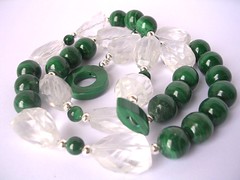
Colour: light to black-green, banded
Hardness: 3.5-4
Cleavage: perfect
Fracture: splintery, scaly
Crystal system: monoclinic, usually found in a massive form.
Chemical composition: copper carbonate
Transparency: opaque, translucent
The name malachite comes from the Greek word for ‘mallow’, a green herb. The ancient Egyptians called it “mafek” along with other green stones. Malachite was popular in ancient cultures for jewellery, amulets and even as a powder for eye cosmetics. It was also used as a pigment for ‘mountain green’ paint. The Russian tsars appreciated the gem and a room of the Imperial Palace was lined with malachite slabs and some Russian Orthodox churches feature massive malachite columns and altars.
The massive form of malachite shows a botryoidal (ball like) form, and the patterns when cut, follow this growth pattern. Pieces without banding are rare. Malachite is found in Russia, Ziaire, Australia, Chile, Namibia, Zimbabwe and the USA.
Metaphysical practioners believe malachite is a powerful stone that is the guardian stone of travelers and is beneficial to pilots in particular. They believe it amplifies energies, absorbs negative energies and pollutants, and helps soaks up radiation of all kinds; that it is an adventurous stone and that life will be lived more intensely as it encourages risk taking and change. Crystal healers advise it should only be used under recommendation.
Moonstone
Hardness: 6-6.5
Cleavage: perfect
Fracture: uneven, conchoidal
Crystal system: monoclinic
Chemical composition: potassium aluminium silicate
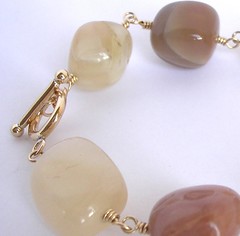
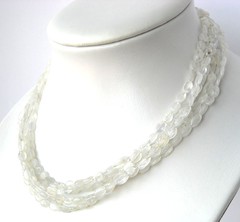
Transparency: transparent, translucent, opaqueAn orthoclase feldspar with a white billowy shimmer called adularescence or sometimes opalescence, reminiscent of moonshine, thus its name. This shine is caused by light bouncing off the internal structure of alternating layers of albite and orthoclase feldspar.
Found in Sri Lanka, Burma, Brazil, India, Madagascar, Mexico, Tanzania, Europe and the USA.
Metaphyiscal practioners believe moonstone to be a stone of new beginnings and through the ages people have strongly connected it to the moon and to intuition. Ancients used moonstone to enhance psychic abilities, for insomia and to prevent sleepwalking. Crystal healers believe it balances, calms overreactions and helps both the digestive and reproductive systems.
Moss Agate
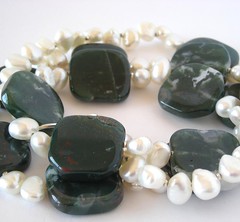
Colour: colourless to white with green, brown or red inclusions
Hardness: 6.5-7
Cleavage: none
Fracture: rough
Crystal system: cryptocrystalline
Chemical composition: silicon dioxide
Transparency: translucent
Moss agate is a translucent chalcedony with inclusions of green hornblende or chlorite in moss like patterns. If the iron hornblende oxidizes, colours can be brown and red. It is used in thinner slabs so that the moss image can be seen clearly. Agate usually refers to a banded stone, but the term Moss Agate for this stone is accepted.
Found in India, China, Russia and the USA.
Metaphysical practioners believe this stone is strongly connected to nature and so it enables you to see beauty in all you see; and that it is beneficial for those working in agriculture or botany. Traditionally, it assited midwives in their work as a charm for lessening pain and ensuring a good delivery and that as a stone of abundance it attracted wealth, improved self esteem and released stress. Crystal healers believed it sped up recovery and boosted the immune system.
Muscovite
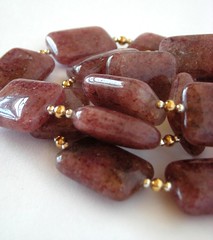
Hardness: 2-3
Cleavage: perfect
Crystal system: monoclinic
Chemical composition:
Transparency: transparent to transluscentA form of mica, muscovite is named after the Muscovy state in Russia, where it was used as a glass substitute in the 14th century. It was also known as isinglass where it was used as a tempered glass. Ground muscovite was used in eye cosmetics and glitter.
Metaphysical practioners consider it to be a mystical, visionary stone that is helpful for those with dyspraxia; that it helps reduce anger and stress and helps looking forward in a positive way; that it can aid clear expression and to help the body achieve its appropriate weight.
Nebula Stone
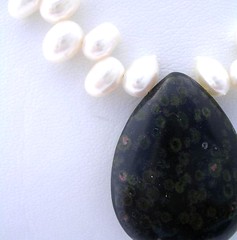
Hardness: 6.5-7.5
Transparency: opaqueA rock rather than a mineral, Nebula stone is a combination of quartz, ribeckite, anorthoclase, acmite, arfedsonite and zircon. It is only a recent discovery and is found in one location the USA.
Nevada Stone
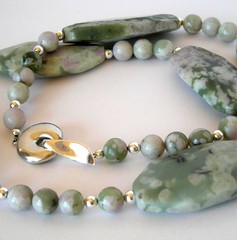
Colour: pink, green, white
Transparency: opaque
Named after the state in which it is found, Nevada stone is a rock composed of eleven minerals: : thulite, scapolite, sericite, diopside and epidote, with minor amounts of feldspar, quartz, zoisite, clinozoisite, actinolite and apatite.
Discovered in 1954 it wasn’t widely known until 1989 and supply is limited. It is sometimes called ‘Nevada Lapis’ or ‘Nevada Jasper’.
Metaphysical healers believe this stone to be a source of creativity and protection, and that it promotes courage.
Obsidian
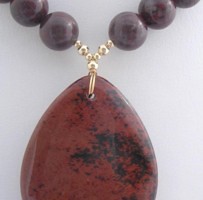
Hardness: 5-5.5
Cleavage: none
Fracture: conchoidal with sharp edges
Crystal system: amorphous
Chemical composition: silicon dioxide
Transparency: transparent to opaqueNamed after the Roman Obsius, obsidian has been used since ancient times in amulets, mirrors and jewellery and in prehistoric times for making tools and weapons.
A natural glass, it is formed from volcanic lava that cooled so fast that crystalisation didn’t occur. Inclusions can cause a metallic sheen. Found in Ecuador, Hawaii, Hungary, Russia, Guatemala, Indoneia, Iceland, Italy, Japan, Mexico and the USA. Can be confused with jet, hematite and onyx.
‘Snowflake’ obsidian has gray-white inclusions that are internal bubbles or crystals that give a snowflake effect, and is found in Mexico and the USA.
‘Apache tears’ are small nodules of dark obsidian found in the USA, particularly in New Mexico and Arizona.
Metaphyiscal practioners believe obsidian to be a powerful stone and that its lack of crystal structure remove limitations in its effectiveness; that it exposes flaws, weaknesses and blockages and removes negative influences. Crystal healers believe many can find the stone overwhelming and it is best used under the guidance of a qualified crystal healer. They believe it can bring clarity and help you learn your true self. Snowflake obsidian and apache tears are believed gentler forms in a metaphysical sense.
Ocean Jasper
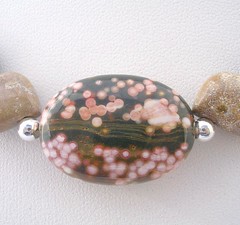
Hardness: 6.5-7
Cleavage: none
Crystal System: cryptocrystalline with occasion druzy crystals
Chemical composition: silicon dioxideOcean Jasper is only found off the coast of Madagascar and can only be mined/collected at low tide. Known for its orbicular patterns, it is a silicifed form of rhyolite.
Onyx (black)
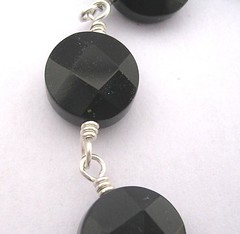
The name used for single coloured chalcedony (agate). The name has its origin in the Greek language and means ‘fingernail’ probably referring ot its translucency. Black onyx is often treated for more uniform colour. See ‘agate’ for further details.
Opal
Colour: all colours – play of colour
Hardness: 5.5-6.5
Cleavage: none
Fracture: splintery, conchoidal, brittle
Crystal system: amorphous
Chemical composition: hyrdrous silicon dioxide
Transparency: opaque to transparent
Opal is derived from the Sanskrit upala meaning precious stone. Dating from the Cretaceous period (when dinosaurs walked the earth), silica gel ran into cavities and fissures where over millions of years it hardened.
There are many origin myths but one of the prettiest is from Arab tradition – when lightning strikes the ground, it leaves small remnants of the lightning captured as flashes in the stone.
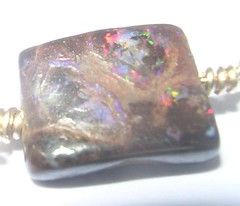
There are ‘precious’ opals – i.e. white, black, boulder and crystal; fire opals that are yellow-red; and common opal which has no colour play.
The mesmerizing colour play that opals are famous for is caused by light reflecting off layers of tiny silica spheres. The size of the spheres indicate the colour that will be seen as flashes when the stone is moved.
Black, white, boulder and crystal comes from Australia. Black opal is the rarest variety and therefore the most valuable. White opal is also mined in Brazil. Crystal opal can be found in the United States (Nevada) and Mexico. Other sources of opal are Guatemala, Honduras, Indonesia, Peru, Ethiopa, Japan and Russia.
Opal was prized by the Aztecs and the ancient tribes of Central Africa. Opal was found in Slovakia up until the end of the 1800s and were featured in the crown of the Holy Roman Emperor and the crown jewels of France. They were mentioned in the plays of Shakespeare and the novels of Sir Walter Scott. Napoleon gave an opal to Josephine. Arabs believed that opals were magical stones that rained from the skies. Zeus was so pleased to defeat the Titans, his tears of joy turned into opals when they fell at his feet. Throughout the Middle Ages, opal was called “ophthalmios” or the “eye stone,” because it was considered beneficial to the eyes. Europeans thought it would make the wearer invisible if wrapped in a fresh bay leaf. And in the Orient opal was cherished as “the stone of hope.”
Fire opal (so named for is orange colour), often shows no play of colour and can be milky and turbid. Fire opal is found in Mexico, Brazil, Guatemala, the USA and Australia. Ethiopian opal looks like a ‘jelly’ (transparent-translucent) opal with the colour flashes suspended within.
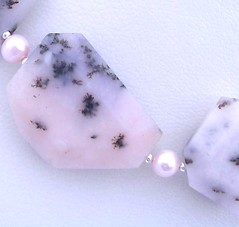
Common opal shows no play of colour. Peru provides a good example of this in the light pink colours. Moss opal is common opal with dendritic inclusions.
As opal is relatively soft, it is best not placed in rings as fine scratches will occur in the surface and the finish will dull.
Metaphyiscal practioners believe opal enhances self-worth, brings lightness and spontaneity; wearing opal is said to bring loyalty faithfulness and strengthens the will to live. Scandinavian women wore opals in their hair to prevent it from going gray. The Arabs thought opal would ward off lightning and grant invisibility to its wearer.